Inflatable moon (an Early Illusion)Our ancestors named one of the days of the week - Monday - after the Earth’s natural satellite. Despite its importance the Moon is the only celestial body not to retain its original mythological name but rather to have been given a decidedly more practical identity (Moon, from the Indo-European root *mens, "the star by which time is measured"). For the Greeks the Moon was Selene, twin sister of Apollo, goddess of love and hunting.
And there is yet another curiosity about the Moon: the Moon Illusion. Stated simply, the full Moon, when just above the horizon, appears twice as large as when it is overhead. Yet the Moon, a quarter of a million miles away from the Earth, always subtends the same angular magnitude (i. e. the angle the Moon subtends at the eye) wherever it is in the sky, roughly 1/2 degree (0.52°). The Moon Illusion has been studied for centuries, and first appeared in a cuneiform inscription on a clay tablet from the Royal Library at Nineveh (Babylon) dating back to the 7th century B.C.! A satisfactory explanation of the phenomenon is still being debated but most agree that the Moon Illusion exists. As explained above, the distance between the Earth and the Moon changes very little – not enough to cause the effects we see. Furthermore, there is an optical contradiction. When the Moon is located at the horizon, its apparent size should be theorically smaller and not larger… As in fact (as shown in fig. 1 above), the Moon at the horizon is a few thousands miles farther away than when it is overhead.

People have thought that the thicker atmosphere along the horizon could act as a magnifying glass enlarging the image of the full Moon when it is on the horizon. That could not be the case as there is not enough atmosphere around the Earth to cause a dramatic lens effect. Anyway, according to the laws of physics, if the atmosphere was really refracting the image of the Moon, it would appear smaller!

Some scientists have proposed that the Moon Illusion effect depends on our perception of the sky as a flat-topped dome the rim of which appears further away than the top of the dome. The effect of this error in perspective is for the Moon overhead to appear smaller than the horizon Moon. The diagram (fig. 2) opposite shows the apparent location of the Moon at various points as it travels across the sky. This is the diagram commonly seen in books promoting this hypothesis… But the diagram can be misleading! The hemispherical flat-topped dome in the picture is not of proven relevance to the effect and ought to be omitted as it falsely suggests a mental process of "projecting" the moon onto that dome.
Others have proposed that the Moon Illusion had to do with the fact that the eye-brain system is designed to work on the horizontal plane, not the vertical plane. On the horizon we process the Moon image in the optimal orientation giving us its true apparent size. Tipping our head back to view the high Moon, we see a non-optimal image. The illusion is not that the horizon Moon is larger, but that the overhead Moon is smaller in size than it "ought" to be. Others have argued that comparisons with buildings and other objects on the horizon are responsible for the differences between the Moon’s apparent size when looking horizontally and looking vertically (this explanation is contradicted by the fact that the Moon Illusion also occurs over open water).
Finally, here is an explanation that is sufficiently satisfactory. The effect of this illusion is due mainly to the fact that our brain interprets the sky as being
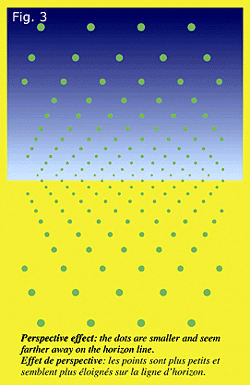
farther away near the horizon, and closer near the zenith (directly overhead, see fig. 3 opposite). This isn’t surprising; look at the sky on a cloudy day and the clouds overhead may be a few kilometers above you, but near the horizon they might be hundreds of kilometers away. The Moon, when it’s on the horizon, is interpreted by your brain as being farther away. Since it’s the same apparent size as when it’s high up, your brain figures it must be physically bigger (as illustrated in fig. 4 further below). Otherwise, the distance would make it look smaller. This effect is the well-known Ponzo Illusion (fig. 5.a). Actually, the Moon Illusion effect is the result of a mix of Ebbinghaus size illusion (fig. 5.b) plus Ponzo illusion (see resulting fig. 6).


-archimedes-lab.org


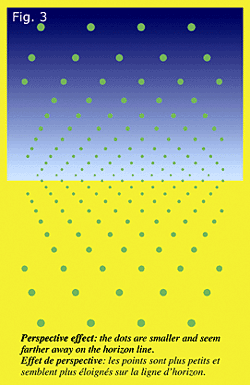 farther away near the horizon, and closer near the zenith (directly overhead, see fig. 3 opposite). This isn’t surprising; look at the sky on a cloudy day and the clouds overhead may be a few kilometers above you, but near the horizon they might be hundreds of kilometers away. The Moon, when it’s on the horizon, is interpreted by your brain as being farther away. Since it’s the same apparent size as when it’s high up, your brain figures it must be physically bigger (as illustrated in fig. 4 further below). Otherwise, the distance would make it look smaller. This effect is the well-known Ponzo Illusion (fig. 5.a). Actually, the Moon Illusion effect is the result of a mix of Ebbinghaus size illusion (fig. 5.b) plus Ponzo illusion (see resulting fig. 6).