Subscribe in a reader

Showing posts with label Illusion Facts. Show all posts

Moon Illusion

Inflatable moon (an Early Illusion)
Our ancestors named one of the days of the week - Monday - after the Earth’s natural satellite. Despite its importance the Moon is the only celestial body not to retain its original mythological name but rather to have been given a decidedly more practical identity (Moon, from the Indo-European root *mens, "the star by which time is measured"). For the Greeks the Moon was Selene, twin sister of Apollo, goddess of love and hunting.

And there is yet another curiosity about the Moon: the Moon Illusion. Stated simply, the full Moon, when just above the horizon, appears twice as large as when it is overhead. Yet the Moon, a quarter of a million miles away from the Earth, always subtends the same angular magnitude (i. e. the angle the Moon subtends at the eye) wherever it is in the sky, roughly 1/2 degree (0.52°). The Moon Illusion has been studied for centuries, and first appeared in a cuneiform inscription on a clay tablet from the Royal Library at Nineveh (Babylon) dating back to the 7th century B.C.! A satisfactory explanation of the phenomenon is still being debated but most agree that the Moon Illusion exists. As explained above, the distance between the Earth and the Moon changes very little – not enough to cause the effects we see. Furthermore, there is an optical contradiction. When the Moon is located at the horizon, its apparent size should be theorically smaller and not larger… As in fact (as shown in fig. 1 above), the Moon at the horizon is a few thousands miles farther away than when it is overhead.

People have thought that the thicker atmosphere along the horizon could act as a magnifying glass enlarging the image of the full Moon when it is on the horizon. That could not be the case as there is not enough atmosphere around the Earth to cause a dramatic lens effect. Anyway, according to the laws of physics, if the atmosphere was really refracting the image of the Moon, it would appear smaller!


Some scientists have proposed that the Moon Illusion effect depends on our perception of the sky as a flat-topped dome the rim of which appears further away than the top of the dome. The effect of this error in perspective is for the Moon overhead to appear smaller than the horizon Moon. The diagram (fig. 2) opposite shows the apparent location of the Moon at various points as it travels across the sky. This is the diagram commonly seen in books promoting this hypothesis… But the diagram can be misleading! The hemispherical flat-topped dome in the picture is not of proven relevance to the effect and ought to be omitted as it falsely suggests a mental process of "projecting" the moon onto that dome.

Others have proposed that the Moon Illusion had to do with the fact that the eye-brain system is designed to work on the horizontal plane, not the vertical plane. On the horizon we process the Moon image in the optimal orientation giving us its true apparent size. Tipping our head back to view the high Moon, we see a non-optimal image. The illusion is not that the horizon Moon is larger, but that the overhead Moon is smaller in size than it "ought" to be. Others have argued that comparisons with buildings and other objects on the horizon are responsible for the differences between the Moon’s apparent size when looking horizontally and looking vertically (this explanation is contradicted by the fact that the Moon Illusion also occurs over open water).

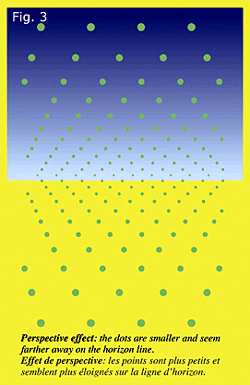
Finally, here is an explanation that is sufficiently satisfactory. The effect of this illusion is due mainly to the fact that our brain interprets the sky as being farther away near the horizon, and closer near the zenith (directly overhead, see fig. 3 opposite). This isn’t surprising; look at the sky on a cloudy day and the clouds overhead may be a few kilometers above you, but near the horizon they might be hundreds of kilometers away. The Moon, when it’s on the horizon, is interpreted by your brain as being farther away. Since it’s the same apparent size as when it’s high up, your brain figures it must be physically bigger (as illustrated in fig. 4 further below). Otherwise, the distance would make it look smaller. This effect is the well-known Ponzo Illusion (fig. 5.a). Actually, the Moon Illusion effect is the result of a mix of Ebbinghaus size illusion (fig. 5.b) plus Ponzo illusion (see resulting fig. 6).


-archimedes-lab.org

How Rainbows Are Made ?

There are two raindrops illustrated on the image.

The droplet with the light rays depicted with colored, solid lines has the long wavelength (red) ray going into the observer's eye. The blue ray depicted by the solid line does not enter the eye. The rain drop with the light rays depicted with colored, dashed lines has the short (blue) wavelength ray going into the observer's eye. The long wavelength (red) depicted by the red dashed line does not go into the eye.

Only one wavelength from a rain drop makes it into the eye. But there are many rain drops, in many different positions and because light will interact with each rain drop in the same way, there is steady progression from long wavelengths (red) near the top of the rainbow to short wavelengths (blue) near the bottom of the rainbow with the yellow and green colors in between.

When we see a rainbow be aware that the entire sky is loaded with raindrops. Yet, we see only a narrow band of color we call a rainbow. That is because the eye receives only a narrow band of rays from a narrow band of raindrops. None of the other light rays reflected from the other raindrops make it into our eyes from the particular position we are in at any one time.

Some Popular Myths

Here are a few popular myths that are too good to be true!

It takes seven years to digest gum.

While it may prove a bit more difficult to break down than organic foodstuffs, chewing gum gets no special treatment from the digestive system. Doctors figure this old wives’ tale was invented to prevent kids from swallowing the rubbery substance.

Hair and fingernails continue growing after death.

Though hair and fingernails appear to keep growing after death, this is merely a morbid optical illusion at work. In death the human body dehydrates severely, retracting enough skin to expose more nail and hair.

The five second rule.

Having an arbitrary rule justifying the consumption of food dropped on the floor within a certain time frame is convenient, especially when said food is a brownie. Unfortunately, tests (and logic) confirm that germs will stick to most foods right on contact.

Virgin Mary Appears On Lemon

WATAUGA, Texas, Sept. 19 (UPI) -- A Texas bar owner who happens to be a police officer says he was shocked when he learned his son saw the face of the Virgin Mary in a lemon slice.

Sam Nance, a member of the Watauga police force, said his son, Marty, revealed the Virgin Mary's face on a lemon he was cutting at the family's business, the Texas Billiards bar, The Fort Worth Star Telegram reported.

"It kind of freaked me out," Nance said. "I'm a detective, and I believe in facts."

When he looked at the lemon, Nance said he sort of saw the face. It wasn't until he took a picture of it that the countenance really was visible to him.

Nance is Methodist and his wife is Baptist, and they don't attend church every week. He said they're saving the lemon in their freezer so others can see it.


Word Association Illusion with Mathematics

I recently heard illusionist Criss Angel on a radio show discussing his work. The key to any illusion is convincing the audience that they’re somewhat in control of what they’re experiencing, when in fact the illusionist is controlling the situation.

To illustrate this, Criss tried something live on the air, claiming that he was going to control the masses. However, he made an error in his delivery, and it didn’t work. I backed up a bit and broke it down, pinpointing the error. It’s actually very cool. Try it on your friends.

Here it is, with the corrections, along with one embellishment:

Men: Think of an odd number between 1 and 10.

Ladies: Think of an even number between 1 and 10.

I’m going to state some words after each number. When you hear your number, remember the word. Here we go:

1. Precious metal
2. Yarn
3. Cutlery
4. Golden color
5. Highly polished
6. Ball
7. Sharp
8. Cat’s toy
9. Kitchen utensil
10. Round

Now, everybody should be thinking of the word associated with their number. I want everybody to forget their number and think of their word. Now I’m going to rattle off some objects. When you hear an object that you can associate with your word in the best possible way, I want you to lock on to that object.

– Blue felt tip pen
– Penny postage stamp
– Carving knife
– Yellow ball of yarn
– Original oil painting
– Old felt hat
– South sea island
– Western stage coach
– Antique clock
– China coffee cup

Now everybody should have the final word they’re thinking of. Envision it falling from the sky towards you. You might want to step out of the way, since you’re probably thinking of a carving knife.

Ladies need not worry, because they’re thinking of a yellow ball of yarn.

For comparison, below is Criss’s delivered version, with the embellishment and error in bold:

Men: Think of an odd number between 1 and 10.

Ladies: Think of an even number between 1 and 10.

I’m going to state some words after each number. When you hear your number, remember the word. Here we go:

1. Precious metal
2. Yarn
3. Cutlery
4. Golden color
5. Highly polished
6. Ball
7. Sharp
8. Cat’s toy
9. Carving tool
10. Round

Now, everybody should be thinking of the word associated with their number. I want everybody to forget their number and think of their word.Now I’m going to rattle off some objects. When you hear an object that you can associate with your word in the best possible way, I want you to lock on to that object.

– Blue felt tip pen
– Penny postage stamp
– Shining silver
– Carving knife
– Yellow ball of yarn
– Original oil painting
– Old felt hat
– South sea island
– Western stage coach
– Antique clock
– China coffee cup

Now everybody should have the final word they’re thinking of. Envision it falling from the sky towards you. You might want to step out of the way, since you’re probably thinking of a carving knife.

Ladies need not worry, because they’re thinking of a yellow ball of yarn.

Note here that I changed Criss’s ‘9. Carving tool‘ to ‘9. Kitchen utensil’, just to make it less obvious what’s happening. The error lies in the second batch of words that he rattled off, which included Shining silver. It was Shining silver that I locked onto, when in fact he’d intended me to think about the Carving knife.

This illusion reminds me of another classic that’s been around for a while. Max Maven told it to me once at the Magic Castle. Good stuff. The key is the delivery; keep talking quickly and don’t lose control of the situation. If you pause too long, you give the audience the opportunity to think of the less obvious objects.

It goes like this:

Think of a number between 1 and 10, but don’t tell me.

Now double it.

Now add 8 to that. You have new number.

Take your new number, and divide it by 2. You have a new number once again.

Now, I want you to subtract your original number from the number you have now. Concentrate on this number.

Let’s switch gears. I want you to think of the letter in the alphabet that corresponds with your number. That is, if your number is 2, think of B. If your number is 3, think of C. And so on.

Concentrate on that letter. Got it? OK, now, think of a country that begins with that letter. Can be anywhere. Got it? Great. Now concentrate on your country.

With your country in your mind, let’s go to the next letter in the alphabet. So, if your country begins with B, go to letter C. And so on.

You’re now thinking of your country and your other letter. Now, think of an animal that begins with that other letter. Got your animal? Good. Now concentrate and visualize the color of that animal. Got it? Good. Now concentrate on three things: your country, your animal, and the color of the animal. Try to see it in your mind.

Just remember that there are no grey elephants in Denmark.

Even babies can have optical illusions

Five-month-old Samuel doesn't seem at all worried about the large plaster covering his right eye. He gurgles contentedly and tugs inquisitively at the white curtain in front of his nose, until it is lifted up by an invisible force. Now Samuel is looking at a chessboard which is drawn in such a way that it seems to be receding into the distance away from him. From this background two bright orange hippos are staring at him; Samuel looks back at them with interest. He tries to grab hold of the hippo which is located a little lower down than the left-hand hippo; it squeaks and the curtain falls. When it goes up a few seconds later, two pelicans have taken over from the hippos. This time the left-hand pelican is lower down. Samuel reaches out for the bright red beak, there is a squeak and the curtain falls. After two dozen repetitions a voice in the background says, "Thank you, that'll be all," thereby ending Samuel's guest appearance at the University of Bonn's Institute of Psychology.


Baby Samuel taking part in the perception test.
(Photo courtesy of University Of Bonn)

"What we are investigating here is at what point babies can begin to decipher visual data about perspective," says Laura Hemker, who is doing her PhD at the Institute. The problem is that even the brightest baby cannot yet say, at the age of five months, what it can see. For this reason the researchers on Dr. Michael Kavšek's team had to think up a trick enabling them to detect the perceptive faculties of their little guinea pigs. "If you offer a baby two toys, it usually goes for the nearest one," Laura Hemker explains. "We make use of this fact for our experiment." The PhD student put 20 seven-month-old babies and 20 five-month-old babies in front of the chessboard background. Due to the perspective figures which are fixed higher up and near the horizon appear further away than rubber toys which are a little lower down – although this is only the case if the observer covers over one eye. Otherwise the stereoscopic data provided by a pair of eyes cancel out the effect of perspective faked by the chessboard. "This is precisely what we observe with our babies," adds Julia Niehl, one of the students assisting in the project. "If they can use both eyes they choose one of the two toys at random. However, when we cover over one eye, they more often go for the toy located lower down which appears closer because of the data on perspective contained in the background image."

At any rate, 19 of the 20 seven-month-old babies went for the lower one rather than the higher one significantly more frequently when they could only use one eye. In eight out of ten cases they first tried to touch the toy that seemed nearer. However, if they were allowed to use both eyes, the location of the toys had no effect on the toys selected.

Even in the case of the five-month-old babies it was 16 out of 20 who reacted to data on perspective – which came as a surprise to the psychologists, as previously most experts had assumed that babies did not acquire this ability until about the age of seven months – "and that this took place, so to speak, from one day to the next, almost as if someone had flicked a switch," says Dr. Kavšek, who heads this study on perception. "Our findings, however, seem to point to a continuous process of development: babies become aware of depth-of-field data at a very early age; the older they are, the less obvious the signals need to be and the better it works."

Probably the perception of perspective kicks in even earlier. However, to test this hypothesis the psychologists would have to change the way their experiment is set up: most babies cannot reach out for something specific until they are four or five months old.

Note: This story has been adapted from a news release issued by University Of Bonn.

Do Animals have illusions?

J. J. Gibson, Cornell University

The World Wide Web distribution of James Gibson's "Purple Perils" is for scholarly use with the understanding that Gibson did not intend them for publication. References to these essays must cite them explicitly as unpublished manuscripts. Copies may be circulated if this statement is included on each copy.

The evolution of the senses (perceptual systems) must have been a continuous process of eliminating misperceptions. If, in general, "things were not what they seemed" to animals, they could not be coped with. Hence the class of illusions that (1) mislead the observer so as to arouse inappropriate behavior and that (2) occurs regularly in Nature should not be manifested in the perception of animals.
There is, of course, a class of experiences that does not elicit overt behavior. Afterimages are an example. They are "subjective" experiences or so called "private" experiences, and are therefore not perceptions in the common use of that term. It would be very difficult to determine whether animals have afterimages. If they do, it is likely that they would pay no attention to them.
There is another class of experiences which are not subjective or private, are similar to perceptions, but are nevertheless false. Images (virtual objects) in still water or in a mirror are examples. Such virtual objects are presumably falsely perceived by all seeing observers, animal or human. It may be that inappropriate behavior has to be unlearned (extinguished) in such cases. (Rainbows do not elicitbehavior.) Pictures are another example.
The straight stick which appears bent when partially immersed in water is similar to cases of the latter class. The "percept" is simply the result of the fact that the visual perception of objects depends on the optic array entering the eye. There is information in the light for a bent stick, and it can only be disallowed by what is rightly called inferential knowledge (i.e., knowledge about refraction). But this is true only so long as the stick is not moved.
When the stick is moved, and especially when it is rotated (as we have shown) there exists a different level of information in light: the invariants of changing perspectives over time. One of these invariants (information for straightness) as we have shown can be noticed by young children, who cannot possibly "know" about the laws of refraction.
The moral of all this is that invariant detection over time is a useful dimension of sensitivity and that the perceptual system will tend to develop such kinds of sensitivity. But, along with these, there will inevitably be useless dimensions of sensitivity that are merely incidental to the useful ones. Animals could not evolve the ability to detect solid tridimensional shapes without incidentally having the ability to detect flat bidimensional forms (frozen pictorial forms). But this so called "form sense" never did animals any good until man began to exploit it, quite recently, by making pictures on flat surfaces. Euclidean and Platonic forms are wonderful inventions for teaching mathematics but they have caused hopeless confusion in the problem of understanding visual perception. We have taken for granted that visual forms, perspectives, were the basic elements of object-perception ­ the sensory basis of object perception.

Popular Posts

.